

Introduction of human body
Human anatomy is one of the basic essential sciences of medicine, concerned with the study of the structure of organisms and their parts including their systems, organs and tissues. Anatomy mean cutting parts
It includes
1-The appearance
2-Position of the various parts.
3-The materials from which they are composed.
4- Their locations .
5-Their relationships with other parts.
Methods used include dissection, in which a body is opened and its organs studied, and endoscopy, in which a video camera-equipped instrument is inserted through a small incision in the body wall and used to explore the internal organs and other structures. Angiography using X-rays or magnetic resonance angiography are methods to visualize blood vessels.
In addition to visual, there are three other methods by which anatomy is studied: palpation, which is physical contact ;Auscultation, such as when a doctor listens to your breathing; and percussion, such as when a doctor taps on your chest. Medical devices such as CT scans or magnetic resonance imaging (MRI), and dissection can also be used to assist in the study of anatomy.
Types of anatomy
Comparative anatomy
- Description and comparison of the form and structure of different animals.
Developmental anatomy
- The changes in form from fertilization to adulthood, including embryology, fetology and postnatal development.
Gross anatomy( Macroscopic anatomy)
- That dealing with structures visible with the unaided eye. Called also macroscopic anatomy.
Microscopic anatomy
- Anatomy revealed by microscopy; includes histology and cytology.
Morbid anatomy
- Anatomy of diseased tissues. Called also pathological anatomy.
Pathological anatomy
- See morbid anatomy (above).
Radiological anatomy
- Anatomy revealed by the techniques of radiography and fluoroscopy.
Special anatomy
- Anatomy devoted to study of particular organs or parts.
Topographic anatomy
- That devoted to determination of relative positions of various body parts; regional anatomy.
X-ray anatomy
Tissue cells
All organisms, from the simplest to the most complex, are composed of cells—whether the single cell of a bacterium or the trillions of cells that constitute the human body. These cells are responsible for all structural and functional properties of a living organism.
Cytology, is the science deal with the study of cell structure and function, is therefore indispensable to any true understanding of the workings of the human body, the mechanisms of disease, and the rationale of therapy.
The modern cell theory:
- All organisms are composed of cells and cell products.
- The cell is the simplest structural and functional unit of life. There are no smaller subdivisions of a cell or organism that, in themselves, are alive.
- An organism’s structure and all of its functions are ultimately due to the activities of its cells.
- Cells come only from preexisting cells, not from nonliving matter. All life, therefore, traces its ancestry to the same original cells.
- Because of this common ancestry, the cells of all species have many fundamental similarities in their chemical composition and metabolic mechanisms.
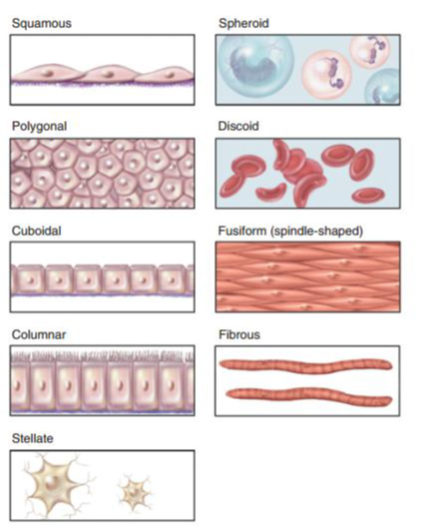
Cell Shapes and Sizes
Most human cells range from 10 to 15 micrometers (um) in diameter. (The human egg cell, an exceptionally large 100 um in diameter.
Elementary tissues of the body
Human body generally consist of five elementary tissues
1-Epithelial tissue
consists of a flat sheet of closely adhering cells, one or more cells thick, with the upper surface usually exposed to the environment or to an internal space in the body. Epithelium covers the body surface, lines body cavities, forms the external and internal linings of many organs, and constitutes most gland tissue.